Published in The Herald, 30 September 2026.
A qualification used to be more than a piece of paper. In healthcare especially, it should represent the ability to solve problems, save lives and improve communities. Yet too many of Zimbabwe’s health programmes still produce young people who can name diseases but struggle when the real work begins.
At the Harare Institute of Public Health, we believe health education must move beyond qualifications. A certificate should prove that a graduate can apply what they have learnt. Are they ready for the workplace? Can they identify problems and create solutions? Have they prepared to serve communities where their skills are needed most?
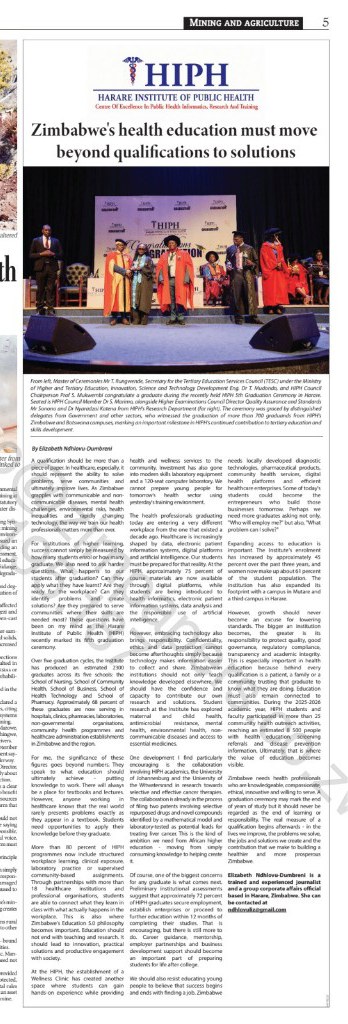
HIPH recently marked its 5th graduation ceremony. One generation of technologists goes out into the field. These programmes — the School of Pharmacy, School of Community Health and School of Health Technology — are now sending graduates into hospitals, pharmaceutical companies, non-governmental organisations, community health programmes and health enterprises across Zimbabwe and beyond.
For me, the significance of these ceremonies is not the certificate. It is whether that education prepared someone for the world beyond the lecture room. Anyone working in healthcare knows that the real world rarely presents problems exactly as they appear in a textbook. Students need opportunities to apply their knowledge before they graduate.
More than 80 percent of HIPH programmes now include structured workplace learning, clinical exposure, laboratory practice or supervised community-based assignments. Through partnerships with more than 70 health facilities, students are able to connect what they learn in class with what actually happens in communities. This is in line with Zimbabwe’s Education 5.0 philosophy: learning should not end with teaching and research. It should lead to innovation, practical solutions and productive engagement with industry.
At HIPH, the establishment of a Wellness Clinic has started another path. Students do not only learn theory. They also gain experience while providing community health services. Our students have also gone into modern skills laboratories and a 120-computer laboratory, preparing young people for tomorrow’s health workforce.
The health professionals graduating today are entering a very different economy from the one that existed 20 years ago. Healthcare is increasingly shaped by data, diagnostics, digital platforms and artificial intelligence. Our students must be prepared for that reality. At HIPH, approximately 75 percent of lessons are being delivered through digital platforms, while students are being trained in electronic health records, data analytics and telehealth.
However, embracing technology also brings responsibility. Confidentiality, data protection and patient safety cannot become an afterthought. Technology makes information travel faster, but it should never outrun ethics.
This is especially important in health qualifications because, beyond every qualification, is a patient, a family or a community. During the last academic year, HIPH students actively participated in more than 25 community health outreach activities, reaching an estimated 8,500 people. These activities included HIV awareness, mental health promotion, cancer awareness, and referrals and clinical guidance. A qualification only has meaning when the value of education becomes visible in the community.
Zimbabwe needs health professionals who are knowledgeable, compassionate, ethical, innovative and willing to serve. A year of study should never be regarded as the end of learning or responsibility. The real measure of a qualification begins afterwards — in the problems we solve, the institutions we improve, the patients we serve and the contribution that we make to building a healthier, more prosperous nation.
Elizabeth Ndhlovu-Dumbreni is a trained and experienced journalist and HIPH’s group corporate affairs official.